

French Passé Composé with Être – Verb List and Agreement Rules
Le Passé Composé with Être
The passé composé of certain French verbs uses the present tense of être as a helping verb (auxiliary). To form the passé composé, you need to add the past participle of the verb you want to use in the past tense.
When using être as the helping verb, you must make the past participle agree with the subject in gender and number.
You can download a free PDF of this list in my private French Grammar Library.
Watch my video lesson on this grammar topic below. I’ll explain the rules with lots of examples.
Many verbs that use être as a helping verb are intransitive verbs, which means they are not followed by direct objects.
Although many of these verbs involve some type of motion, it is important not to confuse verbs that use être as a helping verb with action verbs. Many action verbs use avoir as a helping verb.
Most of the verbs on the following list express a change of place, state, or condition. We can think of verbs that use être as verbs that indicate some sort of coming or going, even in a metaphorical sense, such as being born and dying.
Reflexive verbs are not included in this list, but it is important to remember that they also use être as a helping verb in the passé composé. You can learn more in my lesson on common French reflexive verbs.
Some of the verbs on the following list can also use avoir as a helping verb when they are followed by a direct object. I’ll explain this further below.
CONJUGATION OF HELPING VERB ÊTRE
Before looking at the complete list, let’s review the present tense conjugation of être:
| Subject | Être |
|---|---|
| Je | suis |
| Tu | es |
| Il / Elle / On | est |
| Nous | sommes |
| Vous | êtes |
| Ils / Elles | sont |
Le Passé Composé With Être Verb List
The following verbs use être as their helping verb in the passé composé when they are used without a direct object.
| French verb | English meaning | Past participle |
|---|---|---|
| aller | to go | allé |
| arriver | to arrive | arrivé |
| descendre | to go down | descendu |
| devenir | to become | devenu |
| entrer | to enter | entré |
| monter | to go up | monté |
| mourir | to die | mort |
| naître | to be born | né |
| partir | to leave | parti |
| passer | to pass by / stop by | passé |
| rentrer | to return / go home | rentré |
| rester | to stay | resté |
| retourner | to return / go back | retourné |
| revenir | to come back | revenu |
| sortir | to go out | sorti |
| tomber | to fall | tombé |
| venir | to come | venu |
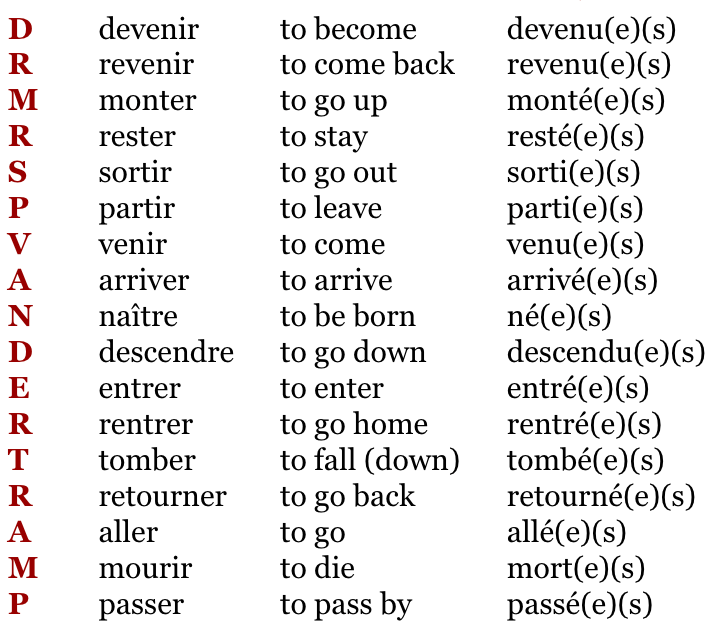
DR MRS VANDERTRAMP
A popular way to remember many of the French verbs that use être in the passé composé is the mnemonic DR MRS VANDERTRAMP.
You can use this expression to help remember the main verbs, although it is important to learn the individual verbs and their past participles, too.
Past Participle Agreement with Être
One of the most important things to remember when using être as a helping verb in the passé composé is that the past participle agrees with the subject.
This means that you need to pay attention to whether the subject is masculine or feminine, singular or plural.
Here are the endings you need to remember:
- Masculine singular: no additional ending
- Feminine singular: add -e
- Masculine plural: add -s
- Feminine plural: add -es
Let’s look at a few examples:
MASCULINE SINGULAR
Paul est allé au cinéma.
Paul went to the movies.
FEMININE SINGULAR
Marie est allée au cinéma.
Marie went to the movies.
MASCULINE PLURAL
Paul et Marc sont allés au cinéma.
Paul and Marc went to the movies.
FEMININE PLURAL
Marie et Sophie sont allées au cinéma.
Marie and Sophie went to the movies.
Notice that the helping verb être changes depending on the subject, and the past participle also changes to agree with the subject.
Here are a few more examples:
- Je suis arrivé(e) en retard. – I arrived late.
- Nous sommes partis tôt. – We left early.
- Elles sont devenues amies. – They became friends.
- Il est tombé dans la rue. – He fell in the street.
- Elle est née en France. – She was born in France.
Special Verbs That Use Both Être and Avoir
Some verbs on the être list can also use avoir as a helping verb. The auxiliary depends on how the verb is used.
The verbs to pay special attention to are:
MONTER, DESCENDRE, SORTIR, RENTRER, RETOURNER, PASSER
When these verbs are used without a direct object, they generally use être. When they are followed by a direct object, they use avoir.
Compare these examples:
| With Être | With Avoir |
|---|---|
| Je suis monté(e). | J’ai monté l’escalier. |
| I went upstairs. | I went up the stairs. |
| Je suis descendu(e). | J’ai descendu les bagages. |
| I went downstairs. | I took the luggage downstairs. |
| Elle est sortie. | Elle a sorti les chaussures. |
| She went out. | She took out the shoes. |
| Je suis rentré(e). | J’ai rentré la voiture. |
| I went home. | I brought the car inside. |
| Il est retourné au café. | Il a retourné la crêpe. |
| He went back to the café. | He turned the crêpe over. |
| Je suis passé(e) chez toi. | Je t’ai passé le sel. |
| I stopped by your place. | I passed you the salt. |
The important thing to remember is that the auxiliary changes depending on whether the verb has a direct object.
You can find a more detailed explanation and additional examples in my lesson on special French verbs that take être and avoir in the passé composé.
What About Reflexive Verbs?
Reflexive verbs also use être as a helping verb in the passé composé.
For example:
- Je me suis levé(e). – I got up.
- Elle s’est habillée. – She got dressed.
- Nous nous sommes promenés. – We went for a walk.
- Ils se sont réveillés. – They woke up.
The agreement rules for reflexive verbs can be a little different, so it is important to study them separately.
You can find a complete list of common verbs in my lesson on common French reflexive verbs.


